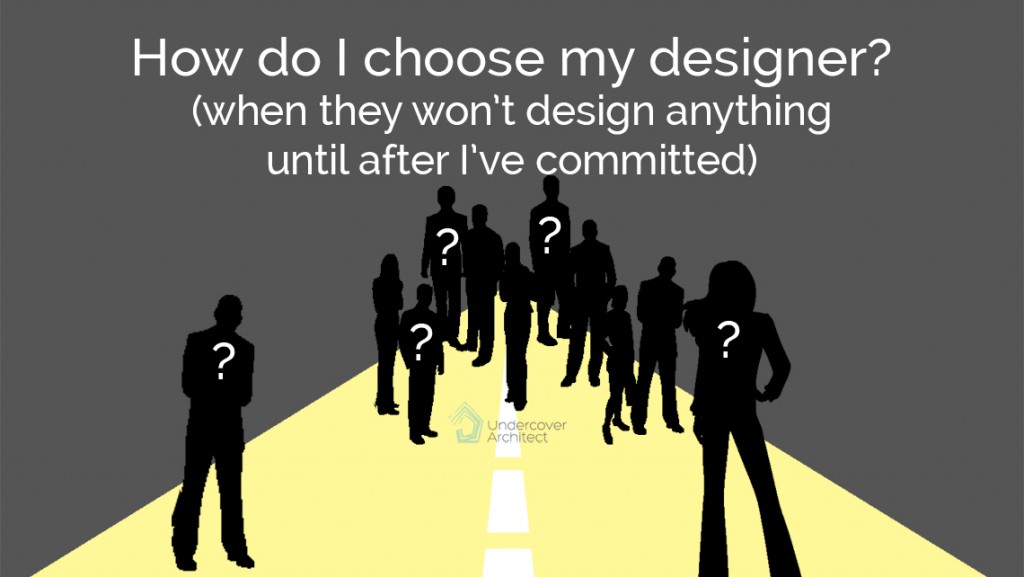
Choosing a designer can be challenging, when you can’t see their work on your project until after you’ve signed on the dotted line. Here’s how to choose.
This is a question I commonly receive from homeowners:
“How do I choose a designer for my home – when I can’t really see if they’re any good until after I’ve contracted them?”
It’s a great question.
Honestly, finding the right people to work with – be your designer, your builder, or other people on your team – is one of the most significant components to get the best from your project, and have things running smoothly overall.
(I’ve written before about this, in this blog about communication.)
So, let’s dive straight in to nutting this out … how DO you choose an architect or designer when you don’t really know what their design ideas for your place will be until after you’ve signed them up?
Very simply, there’s one way … and it’s this:
Pay them to do that first design concept for you. Know you can walk away without paying anymore once it’s done, if it hasn’t worked out the way you hoped.
Too simple? A little …
The process of finding the right designer for you and your home is a little more complex than just paying a raft of them for that first concept until you can shout ‘bingo that’s it’.
It’s more about finding ‘your’ designer … the one that will suit you and your project. So how do you do THAT? Well, I’ve got some tips for you …
TIP NUMBER 1: Do your homework
As with choosing any consultant, tradesperson, or professional to help you in any area of your life, doing your homework is key.
I’ve said this before, and I’ll say it again. In fact I’ll say it till the proverbial cows come home and I’m blue in the face.
Your home is important. You are important. This is about more than just accommodating you and your family, and putting a comfortable roof over your head.
How you invest your time, your energy, and your money … where you choose to spend it … has a significant impact on the outcome it creates and the life it helps you to lead.
So finding trusted partners to support you in that journey, who are in your corner, understand you and your needs, and respect the privilege of the duty they’re being entrusted with, will take time and some care.
If you find someone …
- get to know them. Be it meeting them in person, speaking to them on the phone, corresponding via email – whatever works for you to feel comfortable
- ask for references – either directly from them, or from people you know who know them
- check those references
- balance any negative feedback with the positive feedback and keep a balanced view
- check out their previous projects
- review their career history and training (if they’re an architect, know that they need to be registered with the Board of Architects to be calling themselves an ‘architect’ too)
TIP NUMBER 2: Trust your intuition
OK, so chances are, if you’re hiring a designer – be it a building designer, architect, interior designer – to help you realise the vision you have for your home … they’re going to be in your life for a while.
In my experience, it actually becomes quite an intimate relationship. Whether it’s a one hit design concept, or working with a client over a period of a year or so, I get to know my clients well. I have to, to help create a home that will support them in the life they wish to lead in it. That means we spend time together, we talk about their hopes, dreams, financial position, how they spend their time, how they want to raise their kids, who they want to have in their home, their tastes, likes and dislikes. What I design, help create, shapes how they live their lifestyle in that home. From how they make brekkie each morning, to where they store their nickers, to how they watch TV together as a family, have friends around, right through to where they put their Christmas tree up.
We get to know each other whilst we build a relationship where honest conversations can occur to get the best outcome for their home.
So get a good feel as to whether this designer you’re choosing is someone you want to have in your life for a period of time.
- Do you think you can trust them with intimate details of how you live your life?
- Can you picture them being a friend outside of your professional relationship?
- Do you get a sense you can trust them, a good gut feel when they’re around?
- Do they gel with you, look you in the eye, seem open and honest in their communication?
- Do they listen to you? Not just hear you, but actually listen TO YOU?
- Do they really want to get to know you, the way you live, the way you want your home to be (or do they just want to put you in a box with every other client they’ve had and create a similar result)?
I think our instincts are a fairly good measure in this instance … but support it with your homework.
TIP NUMBER 3: Go to designers / consultants / professionals who specialise in what you’re looking for
I find one of the mistakes that often gets made in selecting a designer is when homeowners choose them for the wrong reason.
Most designers (architects, building designers, interior designers) have areas of specialty – especially ones that have been in the industry for a while and built a reputation. Their specialty may be their particular style of home design, or that they only take on projects where they do full services (ie follow the project the whole way through). Their specialty may even be that they’re super cheap and just do documentation.
There’s a few examples I’ve seen of this:
- The client who chooses a designer because they want their name and reputation to brand their home, but it comes the pricetag that they don’t want to pay.
- The client who chooses a designer because of their contacts in council, when the designer prides themselves on their design offering instead.
- The client who chooses a designer that produces high-end, bespoke, finely crafted designs but they have a very tight budget
- The client who chooses a super-cheap documentation service and expects a great design result from them.
- The client who asks an architect who specialises in design to just draw something up for them.
- The client who wants a heritage home renovation and goes to a contemporary architect specialising in modern new homes (because they’re a friend of a relative)
Where the danger lies is when the designer says “yes” to a client asking for something they’re not a specialist in. Don’t misunderstand me – they may still be very good at it, but it’s not their area of passion or expertise.
If you go to Shaun Lockyer Architects to have your home designed, chances are it will be because you want your home to look like a Shaun Lockyer-designed home. Shaun’s work is notably recognisable in design, style and aesthetic. His clients come to him generally because they love that style and aesthetic (and they hear of what a great job he does). He only takes clients willing to have him on for the entirety of the project (ie through to completion of construction), because that is what helps him ensure that design, style and aesthetic are delivered holistically.
So, you don’t go to Shaun if you just want something drawn up. Or want your project just managed on site.
What do I specialise in?
Design and coaching.
I have and can do documentation, and also manage projects on site, overseeing the whole project. I’ve done it for small and massive projects.
However, my area of specialty, where I know I make the biggest difference and add the most value is in these two things:
- I can get your design right to create a home that works (for you now, and into the future) quickly, simply and economically.
- And I can coach you through this design process, and through the process overall (helping you feel confident, informed and supported).
So, you don’t come to me if you just want something documented, or your project managed on site either.
So those tips again …
By doing your due diligence, using the personality test, and choosing someone who delivers on the area of specialty you are seeking, you will quickly find designers who suit you, and will help you have confidence they understand you, your needs and your project – before they’ve even put pencil to paper.
But you’re still not sure?
There’s nothing saying that you have to hire a designer for your entire project (unless you sign something that does) to just test the water with them, and get that first design.
If you’re just not sure whether they will be the right team member for you, negotiate partial services with them.
If you’re signing on for a complete service, then be sure that the overall agreement you are signing enables you to terminate at any point and still use any work that you have paid for up until that point. Understand what obligations you’ll have to the designer should you continue to use them beyond your services with them (ie do they still have copyright or need to be acknowledged as the designer if you take the design elsewhere, develop it, get someone else to draw it up, etc).
I also recommend that you don’t expect a designer to work for you for free. To be honest, free work is worth what you pay for it. Nothing. And you won’t value it either. You just won’t – I know this, because I’ve seen it happen, time and time again.
If you are willing to pay for a first-stage concept design, then you can expect that the professional will invest effort, time, skill and knowledge into creating that first-stage concept.
A good designer will respect the trust you have placed in them, and you will value the expertise they bring to the table. An exchange of value is taking place, and it is the best way to test whether working with them will really work overall – for all involved.
And I think that’s really the crux of it …
Remember this is simply an exchange of value. If at any point you feel like the designer you’re working with doesn’t value you, your home, your input, your collaboration, your goals, your vision … then it’s not going to work.
And at any point, you don’t value what the designer brings, what expertise they add, what knowledge they provide, and how they expand your vision for your home … then it’s not going to work either.
It may sound dramatic, but I’ve seen it so many times I’m afraid. Because with that exchange of value comes the building of trust. And trust me … as client and designer, you need to trust each other to get the best out of your relationship, the home you’re creating and the project overall.
As you do your searching, the sooner you can feel this designer will be the very partner you need to make those hopes and dreams you have for your home come into reality, the closer you are to knowing you’ve found the right designer for you.
Other blogs you may find useful …
Don’t know whether to use an architect, a building designer or a draftsperson? Here’s the differences …
Here’s my tips on how to choose the right builder for you.
Bad designer? Bad builder? Things not working out? Here’s what to do.
 With over 30 years industry experience, Amelia Lee founded Undercover Architect in 2014 as an award-winning online resource to help and teach you how to get it right when designing, building or renovating your home. You are the key to unlocking what’s possible for your home. Undercover Architect is your secret ally
Leave a Reply