When you’re building a new home, watching it come to life on site can be one of the most thrilling moments of the entire project.
Join HOME Method members Jan and Landon as they share their passive house construction update.
You’ll hear how their builder’s prefab wall cassette system put their home shell up in just five days – and why precision is everything in a build like this.
Listen to the episode now.
Hello! This is Episode 398, and in it, I’m speaking with HOME Method members Jan and Landon, who are back to share an incredibly exciting construction update on their passive house new build in Sydney’s north.
This is the fifth instalment of Jan and Landon’s journey on the podcast.
As a quick recap: Jan and Landon are building a new home and granny flat as a Passive House in Sydney’s north, on a site that has been in Landon’s family for over 70 years.
If you haven’t heard the updates of Jan and Landon’s project journey in our earlier episodes, I’d highly recommend checking them out. You can find them here:
- Episode 338 >>> Gardens, Grandkids, and Sustainability: Building a new home, with Jan and Landon
- Episode 339 >>> The Granny Flat Dilemma: Custom, PreFab or Kit, with Jan and Landon
- Episode 367 >>> Passive House Design and Budget Lessons: Project Update, with Jan and Landon
- Episode 368 >>> Navigating Interior Design and Other Project Choices for a New Build, with Jan and Landon
They’re both in their 70s and are building with very clear goals, to age in place well, to live sustainably, and to create a home that’s deeply aligned with their values and lifestyle.
As retired teachers, they’ve brought a wonderful learning mindset to this project. They joined HOME Method in January 2024 and have used it as a real foundation for their preparation and decision-making all the way through.
When we last caught up in Episode 367 and Episode 368, the project was well into design and the early stages of construction.
Now, things have moved very quickly, and the home is actually taking shape before their eyes.
Jan and Landon are living on the neighbouring lot to their construction site, so they can quite literally look out the window and watch their home going up.
One of the most compelling parts of this episode is hearing about the prefab wall cassette system their builder uses, and what that’s looked like in practice on site. In earlier episodes, we introduced this system in concept.
Jan and Landon walk us through the reality of it: visiting the panels being built in the factory, seeing the manufacturing drawings that translate the architect’s plans into something that can be precision-built offsite, and watching the entire shell of the house go up in just five days with a crane and a dedicated team.
It’s a fascinating, real-world account of what this construction methodology involves, and of how the precision and accuracy embedded in every stage of that process directly supports their passive house goals.
Plus, they share loads more helpful insights I know you’ll find super helpful for your project.
LISTEN TO THE EPISODE NOW.
Before we jump into my conversation with Jan and Landon, let me share some context about where we’re at in their story.
Jan and Landon joined HOME Method in January 2024.
Their first podcast conversations in Episode 338 and 339 were recorded in September 2024, when their design was getting underway. We caught up again in July 2025 for Episodes 367 and 368, where we went deep into their design decisions, budget, and the collaboration with their team.
This conversation was recorded in March, 2026 and as you’ll hear, a lot has happened since we last spoke.
As this conversation unfolds, I’d love you to notice a few things that I think will be really valuable for you.
Listen out for:
- How Jan and Landon describe what it’s actually like to watch your home come to life on site. You’ll hear, after all the planning, the briefing, the design decisions and the preparation, what it feels and looks like when it starts becoming real in three dimensions.
- The detail behind the prefab cassette system, from the factory visit and the manufacturing drawings through to the five-day installation process, and the importance and benefit of accuracy in this kind of construction methodology.
- How the builder’s approach to his team and his craft speaks to the kind of builder culture that delivers great outcomes on a build like this, and what to look and listen for when you’re choosing your own team.
Let’s hear from Jan and Landon now.
This is the transcript of my conversation with Jan and Landon about their passive house construction update, including how their builder’s prefab wall cassette system built their home shell in just 5 days.
Amelia Lee
Well, Jan and Landon, it is fantastic to have you both here. I’m so looking forward to hearing your update and how your project has been traveling. You’ve been sharing a little bit of updates here and there in the Facebook community in HOME Method, and so, I know that there’s been some really exciting progress, and I’m really grateful for you to be able to make the time for us to hear about where your project is at. I’m wondering, when we spoke last time, you were still largely in design and early construction, and now the home is actually under construction. You’ve seen it come together in real life. Where are you actually up to in the project? And what’s it felt like for you to see it becoming real on site?
Jan
Well, we can look out the window and see our house going up before our eyes. So at the moment, the whole shell of the house is up, and all the builders are working inside at the moment, and we’ve got all the electrical works are roughed out. The plumber’s coming on Friday to start his work. The builders, they’ve taped up the building. They put it, what do you call it? The battens for the internal cladding and all the windows are in. Doors, except for the front door, because I think they’re a bit worried about that becoming scratched or something, so it’s to one side waiting. But the blower door test happens fairly soon, and they’re doing fascias. So, as soon as the fascias and the barge boards are done, they’re going to put the iron on the roof. So, at the moment, it’s covered in an enormous blue tarp, which keeps it weatherproof. So, it’s a bit strange inside. The light’s a bit blue because it comes down over the windows a bit. It feels like it’s going ahead in leaps and bounds. Oh, and all the internal walls are done and the ceiling frames.
So, they’re all ready to be declared as well.
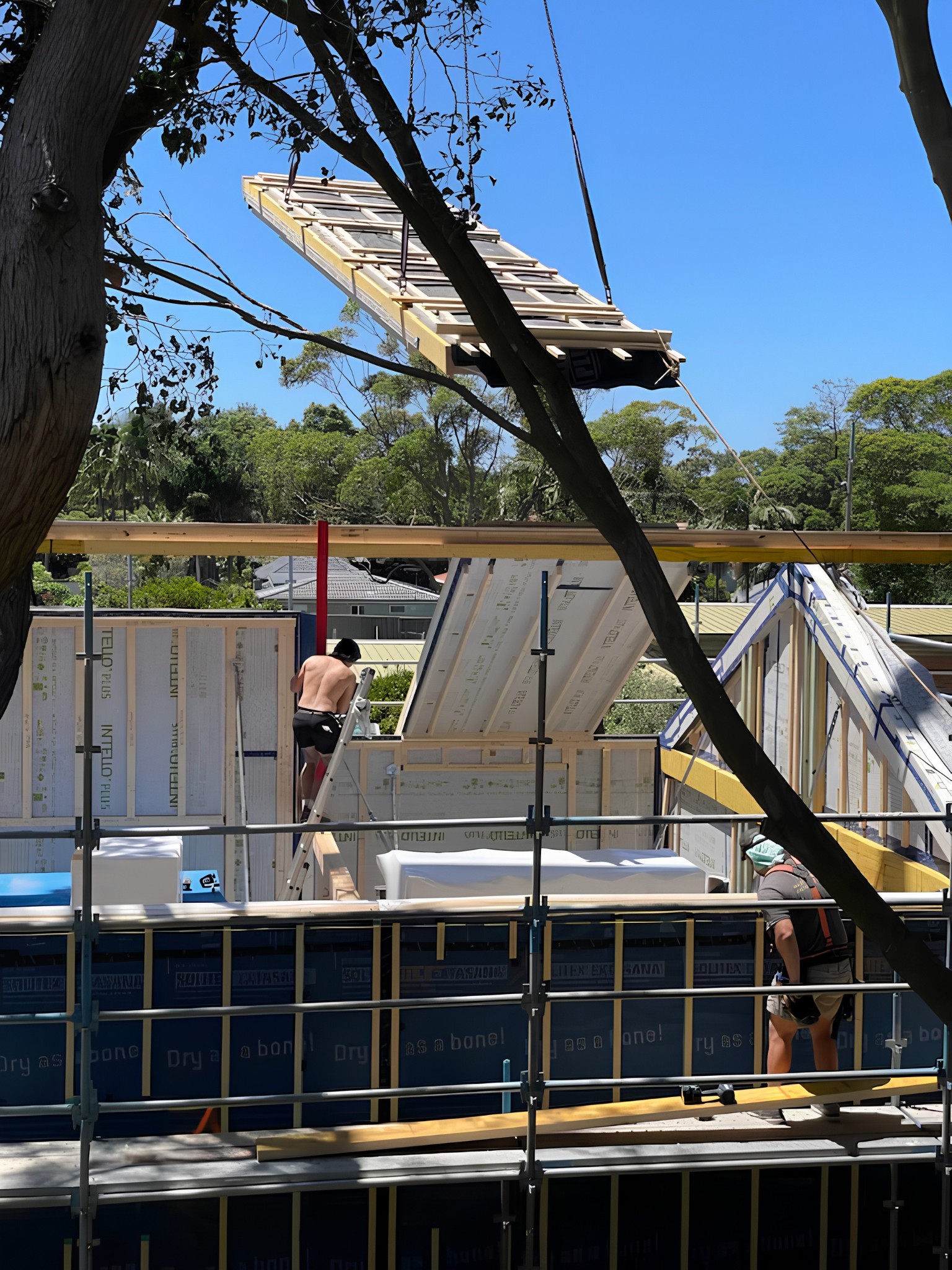
Image of Jan and Landon’s project
Amelia Lee
Gotcha. And you’re living next door and you’re getting to see it all come together. What’s it been like just to see that after all of this planning and preparation and design work and talking about it, to actually see it coming to fruition before your very eyes?
Jan
Well, it’s been thrilling. It’s really entertaining. We’ve got friends that think we should be more anxious and stressed, but it’s just been fantastic, really, because it’s better than television.
We really like the builders that are there, and we know them all by name. And I don’t know, it’s just wonderful to see.
Landon
They’re very young, the builders these days, so I police them.
Jan
It’s been wonderful to get a sense of the volumes. And they were a bit of a surprise, in a way. We knew the plans. We knew how it was going to work, but the first time we walked in, once it had the roof panels on and the sides, it was a real surprise at how high the ceilings were and the volume of space. Oh, it was a thrill, really.
Amelia Lee
Yeah, that’s fantastic. I think it can always be tricky, particularly if you’ve not done this loads of times before, to really expand that sense of three dimensionality from the floor plans. And if you’ve been living in houses that don’t have ceilings the same as what you’re designing, there’s only so much that 3D models can do. But the goal always is for it to be a really exciting surprise rather than a disappointment. So, it sounds to you like it has been. It’s exceeded your expectations in terms of how it’s shaping up.
Jan
I think, maybe there’s been a couple of, “Oh my goodness.” See, because we’ve got raked ceilings in the lounge dining area, which is all open to the kitchen, we asked for a lowered ceiling in the kitchen for something a little bit more cozy and variety.
And I thought when I first walked in, it was too low. And it was only in comparison to the other, and it’s higher than most. Like, it was all relative, really.
Amelia Lee
Yeah.
Jan
Of course, I soon got used to it. And I love it.
Amelia Lee
Yeah.
Landon
And when we first saw when it was all raked, before they put the ceiling frames in, we got used to that. So, it was quite nice walking into the big cathedral. It looks a bit like Marae building in New Zealand.
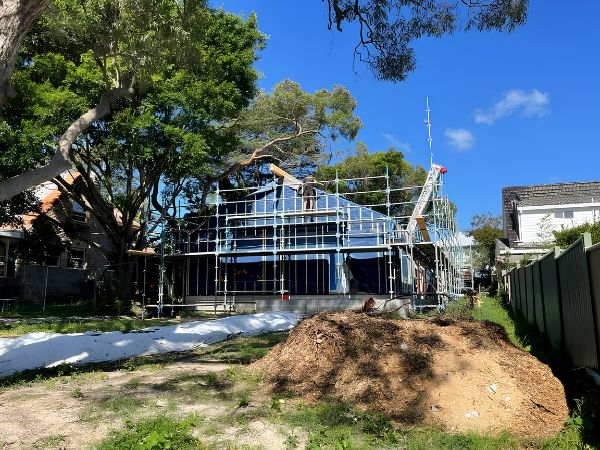
Image of Jan and Landon’s project
Jan
Because it’s a gable roof.
Amelia Lee
Yes.
Jan
People have said, “Oh, it looks like a Maori meeting house.” We love it, actually, we really love it, yes.
Amelia Lee
That’s fantastic. Now, you’ve built this using a prefabricated Passive House system, and now that you’ve seen that unfold on site, how would you actually describe that to somebody who hasn’t experienced before? And what you had to do, I suppose, to prepare for that going into it? And you know how you felt that you could prepare for that with what you’d learned inside HOME Method?
Jan
Do you mean just the erection, or the whole process?
Amelia Lee
Just the prefab panels, I think there’d be lots of people who’d be really excited to hear. Because I can imagine that’s obviously assisted with the speed of getting the building envelope up.
Jan
Yes.
Amelia Lee
So yeah, be really curious to hear how that’s went for you.
Landon
We went to visit the factory. And that was quite good fun. And then we saw the way they were building it. They had these flatbed, big plants, things. So. everything was nice and square, and laser sort of things shining down, so that when they put the invisible stuff on, they knew where the studs were underneath.
Jan
So, I think that the process that interested us was we went through what everybody goes through if you use an architect. We did the brief and the concept drawings, and then eventually got to that point of construction drawings with all the specifications. But there was another process after that.
So, those construction drawings were given to the people in the factory, and they converted those into manufacturing drawings. So that was another whole set, and quite different, very different. Everything numbered so they could see where, how it all fitted together, and that’s what they used to manufacture the panels. You think, ‘Gosh, there was some opportunities there for things to slip through the cracks’, but it didn’t happen. And so, the accuracy was incredibly important. And so then, they stacked everything ready. Once they manufactured the panels, they arranged to have all the base plates around the slab, and that was a big job. And then the day was organised, of course, so that it was a sunny day, a stretch of fine weather, and they allowed for five days, and that’s how long it took the house to go up.
And so, there was a crane, and there was a big team of people. And the interesting part was that the people who put it up with the people who built it in the factory, then the trucks came, one by one, separate, with time between them. The crane unloaded all these panels, and then they started work on the wall furthest to the crane, so at the back of the site. And then they slowly built it like a house of cards. It was so interesting. We had people everywhere, crawling all over. And inside the structure they were making, they were also putting in some internal walls because they helped support what they were erecting.
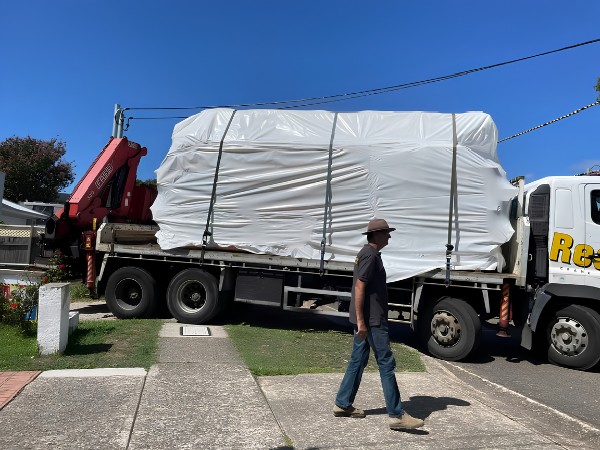
Image of Jan and Landon’s project
Landon
And they had props screwed into the floor and into the walls just to keep everything square.
It was worth noting that when they’re putting the sole plates on the slab, they were incredibly concerned about accuracy of measurements. And that went all the way through the construction, so that everything was very, very precisely measured.
Jan
And re-measured and measured again. So,, that was interesting to us and reassuring, very reassuring, and it all fitted together.
Landon
There are probably problems which we weren’t aware of that the builders dealt with, but they dealt with it as they came along, and it didn’t multiply and become something horrible.
Jan
We heard the builder say to one of the young builders, “Now you might worry about two mils, but you have to worry about two mils being out, because it will multiply, so you’ve got to do it right now.” That was just a little bit of feedback that one of them was getting while it was being erected.
Amelia Lee
Yeah, which is amazing feedback, because often, two mil isn’t worried about too much. That’s fantastic.
Jan
Yeah, that’s what it boiled down it. I said to the builder, “Does it get to be a little bit stressful?” And he said, “No, this is the stuff we know how to do well.” He said, “There’s other stuff I get stressed about, but this is what we do well.” And I can see that was the case.
Landon
The builder using it as a educational thing for the apprentices.
Jan
I think you were going to talk to us about the professional later.
Amelia Lee
Yeah, I wanted to ask you about the professionalism of the builder, because I know that that’s something that you’ve commented on. But first, you mentioned that the people that fabricated them in the factory were the ones that came installed it. So, is that something that the builder always does? Is that he treats them as a subcontractor…?”
Jan
I think he has a team. And when we were in the factory there, that seemed to be two teams building the fabricated panels. And there is one person that seems to mostly stay there, and he’s the one that transfers the architect’s plans to the manufacturing plans.
But even he came out the day they were putting in the base plates. And because he knew that plan so intimately by then. And most of them did, that was really interesting. And he came out and double checked all the base plates, or sole plates, whatever you call them, were accurate. But the people we saw in the factory making our panels were the ones that then come out, especially for the erection for that five days, they were all there. They were everywhere. And I don’t know, we can’t be sure, but I think it must be quite satisfying to be involved in one aspect of the building and then follow it through and see it go up in three dimensions. We have a builder friend neighbour, and he said, often in houses now, they have a team of subcontractors doing bits, and then they move on to another site and never quite get to see what they’re doing, or having a sense of ownership of what they’re doing.
Landon
And in that process, that team does what they need to do. But that might put the next person out.
Jan
Yeah, so here, in this team, they definitely know the whole process of the construction of this building. So, some of those people who are in the factory are in there now doing these internal works. And there might be another team from the factory that’s doing another house. They’re doing one in Marrickville.
Amelia Lee
Yeah.
Jan
So, it’s just an interesting way of learning. It’s a bit like the chefs learning how to best cook. They learn the whole process from the time it’s just a plan that they’re going to do something with and build panels, right to putting on the roof and all of that. And there will be a few subcontractors, but they’re the ones that get used for these buildings, so they know it too.
Amelia Lee
Yeah. And super interesting and useful feedback loop for them, I imagine, in terms of then figuring out, are there any things that they could have done in the manufacture of those panels or the design of them to expedite the process next time? So, really great strategy for that. Because the beauty of those prefab panels is that you get that, as you talked about, that precision, that quality and that speed. But it only works if they’re designed correctly in the first place.
So with everything being so machine-based in that manufacture process, and as you’re talking about land and the use of lasers and robotics and things like that, I’ve been to a fair few prefab factories now, and it is incredible to see the level of precision with which they can build these things. But that all falls apart if it does get to site, and then it can’t be installed with the same level of precision. So, it’s really great to see how well that’s gone for you.
Jan
And the architect, she trained in Passive House construction as well, so that she knows what the builder needs. And also, I don’t know if we’ve ever mentioned this, but our panels are based on a grid.
So, the size of the panels that he builds is designed for efficiency of use of materials. Now, if we’d had twice as much money, maybe we could do whatever we wanted. But we did stick within that framework of the grid. So, the two of them worked quite closely together, so that she knows what he needs and he can trust what she designs that will work for them as a company.
Amelia Lee
Fantastic. Now, you did mention the professionalism of the builder and the team. What have you observed about how they work and how you’ve known that they were the right team for you? I mean, the fact that you said right up front that friends feel like you should be more anxious, but it’s just a thrill for you to see it, that, to me, speaks volumes about this being the right team for you.
So, how have you seen that professionalism playing out in the way that they work?
I was a TAFE teacher, and not in any field related to building, but certainly, in terms of training and assessing people in the workplace. So, on those five days that our building was going up and subsequently, but it was really obvious on this time, the builder was there for the whole time, and he just walked around and around and around the site, and he was giving feedback, he was training, he was asking questions, all sorts of things. Like, it might be the one, you might think two mils is not much, but it can build up and suddenly you’ve got a problem.
Another time, he mentioned two other workers from the past, “Remember how they used to work together, how they could work side by side, but doing separate things? You can try working that way.” So, he was giving them a teamwork type. He was actually training. I told him later, I was really impressed with how he was doing that. So, of course, he was saying, “I think you need to bang that in a little bit more”, or whatever it was, practical things that I don’t understand. But it was far broader than that, stuff to do with teamwork, stuff to do with accuracy, and he was there to answer questions and so on. And he knew those blokes on the site really, really well, and he knew what their skills were, so he was helping them as this building went up.
And we were running around, thrilled.
Amelia Lee
Did you have anything to add, Landon?
Landon
I just wanted to point out that each one of these panels, which they call cassettes, was completely formed. It was timber-framed. It had insulation in there, and the interior wrap and the exterior wrap all in one piece, and any structural timbers that they needed. And so, it was all brought in and erected so that all of that stuff about putting in insulation and stuff had already happened. What the system that they had was that the interior panels had batons with a gap down the bottom, about 300 I think. And so, that meant that things like the wiring and plumbing and services could go through there and in a simplified manner. All of that stuff is very pleasant to see, that they don’t have to tear things apart in order to fit anything else in. So, yeah, it was good.
Amelia Lee
Yeah. I think it really speaks to an understanding from this builder of we use this system because if we can just really nail the accuracy and the manufacturing timelines and the installation of that part, then it streamlines everything from there on in. And it also sets up the project for success in terms of the air tightness that you’re trying to achieve. As you’re saying, Landon, not penetrating walls to then have to come back and patch them up.
Jan
But a lot of that would take a huge amount of training of that team for them to understand that the integrity of those panels is tantamount, and that it’s really important that that builder, then, is keeping an eye on all of that and helping the team to feel empowered in working inside that environment, and not getting slack or lazy or anything like that, of that nature. And I can imagine that you living next door to the site, for a lot of builders, that would probably be their worst nightmare, that they’ve got the client right next door to the site, keeping an eye on things on a daily basis.
I mean, to me, it shows that this builder has faith in their own ability to do this well, and they’re not worried about that.
He definitely has faith in his own ability, and he also trusts us. Well, he set up such a good communication with us, and it all comes from us starting and choosing him and using your questions. And when I said, “Can we ask you lots of questions?” right at the very first interview, and he said, “I like to be honest. I will answer any question you ask, and I’ll be honest, and you can ask me at any time, no matter how difficult the question is.”
And so, that was good. And we try and do the same. And so, I think there is a trust now. And he knows we go next door the minute the builders disappear. And I said to him, “You know that we go next door. But we’re not the sort of people that are doing dumb things.” So, we do know all the builders by name, and what’s up, where they come from, and all sorts of things. And I don’t think they care that we’re here. They don’t mind.
Amelia Lee
Now, the last time that we spoke, we were chatting about the granny flat and the decisions about the granny flat, and we had a conversation at one point about whether you’re entertaining that the granny flat might be a standalone project that you purchase from somebody else. And we talked about whether that was a good strategy or incorporating it into the construction of the home, and using the same team. And we also talked about your desires for the house, in terms of Passive House versus what you might desire for the granny flat, and whether it represented value to you in that regard. Where did you land with all of that? What did you decide to do with the granny flat? How’s it been constructed and what drove that decision-making?
Landon
Well, I think your advice about tying the main house in with the other one was good, and we went with that. So, the architect designed the granny flat, incorporating a garage and a studio space. And it marries really closely to the main building, and it works all together.
Jan
And it’s built with the same panels. The panels have been built. So it will be built to Passive House standard, but we’re not going to have it certified.
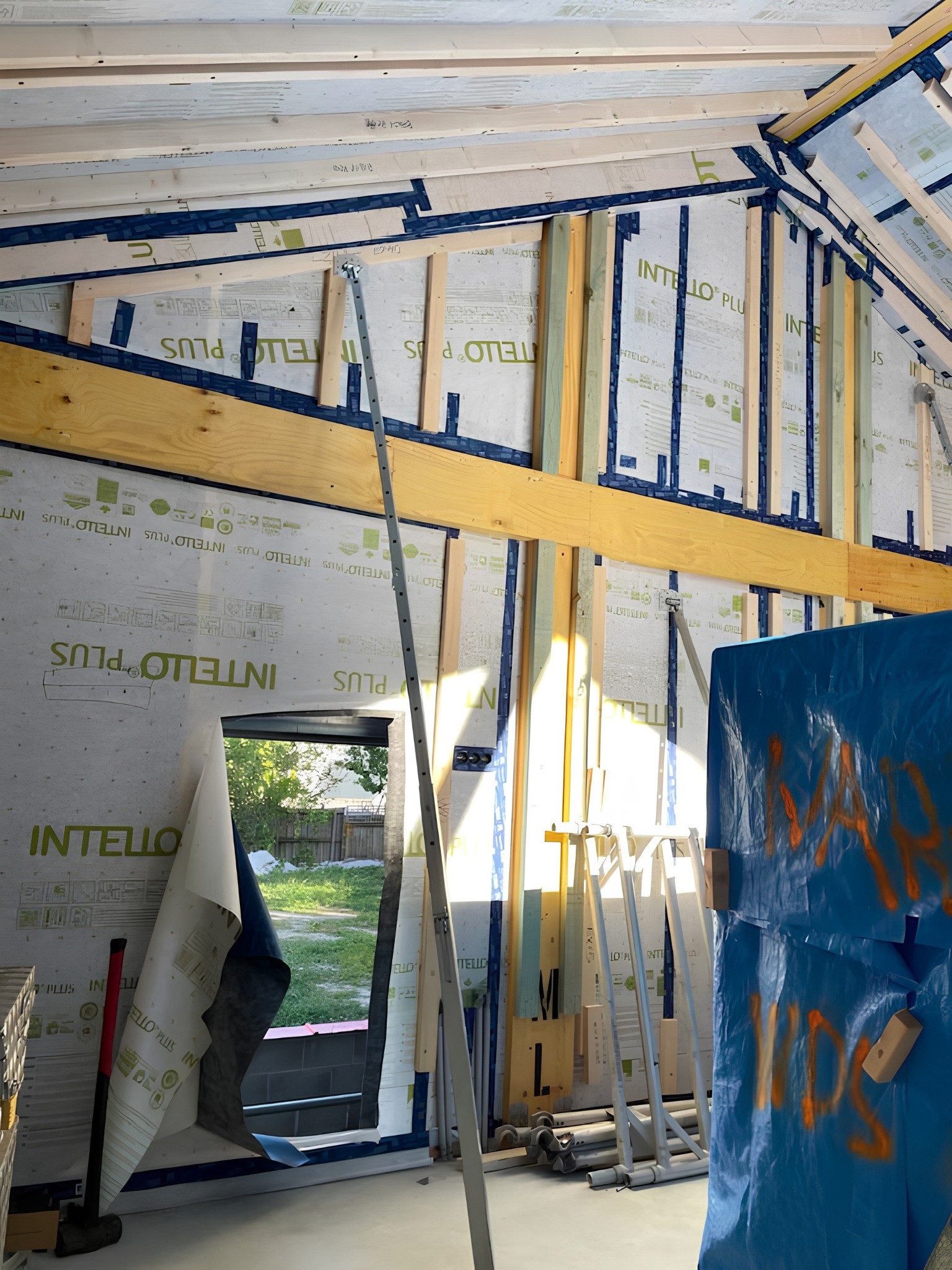
Image of Jan and Landon’s project
Landon
Yeah, the certification process involves experts designing this, that and the other. But it’ll be airtight, and we’ll have ventilation units and all of that sort of stuff, and done to the same standard, but without having all the checks and balances. Because, oh, I don’t know, we just thought it was a bit unnecessary. Yeah, and it will be tested. The builder does this test, but you’ve got to get an outside person in to verify their test.
Amelia Lee
I totally understand. And I mean, it’s where a lot of people land. I think, for my mind, I like the fact that it’s going to be tested, that you’re going to get the blower door test on it because for me, that’s the thing that will help you have some confidence that it actually has been constructed as per the detailing. And getting the little plaque then on the wall isn’t as necessary for you. If you’ve got that documentation and you can see it in action.
Jan
We’ll have it for the house. The house will be certified. And the builder’s point about doing it in a Passive House construction way was that Landon has a studio. And he said, “You don’t want to sit out there and work in the middle of winter and be cold.” He was quite persuasive.
Amelia Lee
Yeah. I think, too, when you talk about long-term, we talked about whether there might be a time that you guys might move into the granny flat and somebody else be in the house, and it’s like, “Well, you built this beautiful home for yourself. And then you’re moving to the substandard one.” Yeah, it’s a good strategy.
Jan
It was a good call from you, your advice, and we followed through, and I think we’re happy with that.
Amelia Lee
Awesome. And the storm water was another area that we were having a chat about, and some of those things that were happening in the garden, around the bunding and the site drainage, how did all of that resolve? Where did you land with all of that?
Landon
Well, that happened quite quickly. We just decided on one of the options, and…
Jan
The OSD.
Landon
The onsite detention on the ground rather than in tanks. I think it’s all over-engineered, of course, but yeah.
Jan
And so, we’ve got the buns, which are mounded things around the garden, encasing or enclosing some drainage connection points to the storm water. We’re just going to landscape it. And we’re not going to sweat this stuff. We just think, yep, it’s cost us less than buying tanks. We’ll have it covered in lots of lovely native shrubs and things. We think it’ll look fine.
Amelia Lee
Yeah, I agree.
Landon
But you’re not supposed to have trees. It’s designed for a specific volume, and if you put trees in that… So, we’re going for grasses, which is very exciting.
Amelia Lee
I think that’ll look amazing. Particularly being able to look out from them and wander around in it.
RESOURCES
Check out Jan and Landon’s previous episodes in the podcast:
- Episode 338 ‘Gardens, Grandkids, and Sustainability: Building a new home, with Jan and Landon’ >>> https://undercoverarchitect.com/podcast-gardens-grandkids-sustainability-building-new-home-jan-landon/
- Episode 339 ‘The Granny Flat Dilemma: Custom, PreFab or Kit, with Jan and Landon’ >>> https://undercoverarchitect.com/podcast-granny-flat-dilemma-custom-prefab-kit/
- Episode 367 ‘Passive House Design and Budget Lessons: Project Update, with Jan and Landon’ >>> https://undercoverarchitect.com/podcast-passive-house-design-budget-new-build/
- Episode 368 ‘Navigating Interior Design and Other Project Choices for a New Build, with Jan and Landon’ >>> https://undercoverarchitect.com/podcast-navigating-interior-design-and-other-project-choices-new-build/
Passive House episodes on Season 8:
- Episode 9 ‘What is Passive House (or Passivhaus)? | Interview with Daniel Kress of Smart Plus Homes’ >>> https://undercoverarchitect.com/podcast-what-is-passive-house-passivhaus-daniel-kress/
- Episode 10 ‘The Client who wanted a Passive House | Interview with David Rhind, Owl Woods Passive House Project’ >>> https://undercoverarchitect.com/podcast-what-is-passive-house-passivehaus-homeowner-owl-woods/
- Episode 11 ‘The Architect who designed a Passive House | Interview with Talina Edwards, Talina Edwards Architecture’ >>> https://undercoverarchitect.com/podcast-what-is-passive-house-passivehaus-architect-talina-edwards/
- Episode 12 ‘The Consultant who tests and measures the Passive House | Interview with Luc Plowman, Detail Green’ >>> https://undercoverarchitect.com/podcast-what-is-passive-house-passivehaus-certified-consultant-luc-plowman/
- Episode 13 ‘The Builder constructing Passive House | Interview with Stuart Lee, Craftsmen Quality Builders’ >>> https://undercoverarchitect.com/podcast-what-is-passive-house-passivehaus-builder-stuart-lee/
- Episode 14 ‘The Certifier and an Australian Passive House Pioneer | Interview with Clare Parry, Grun Consulting’ >>> https://undercoverarchitect.com/podcast-what-is-passive-house-passivehaus-certifier-clare-parry/
- Episode 15 ‘The Passive House Renovator | Interview with Cameron Munro, Armadale House’ >>> https://undercoverarchitect.com/podcast-what-is-passive-house-passivehaus-renovation-armadale-house/
Access the support and guidance you need (like Jan and Landon did) to be confident and empowered when renovating and building your family home inside my flagship online program, HOME METHOD >>> https://undercoverarchitect.com/courses/the-home-method/
Learn more about how to interview and select the right builder with the Choose Your Builder mini-course >>> https://undercoverarchitect.com/courses/choose-your-builder
My free ’44 Ways’ E-Book will simplify sustainability for you, and help you create a healthy, low tox and sustainable home – whatever your dreams, your location or your budget. Access your copy here >>> https://undercoverarchitect.com/ways

 With over 30 years industry experience, Amelia Lee founded Undercover Architect in 2014 as an award-winning online resource to help and teach you how to get it right when designing, building or renovating your home. You are the key to unlocking what’s possible for your home. Undercover Architect is your secret ally
Leave a Reply